Early life and formation
1813–1837 0 works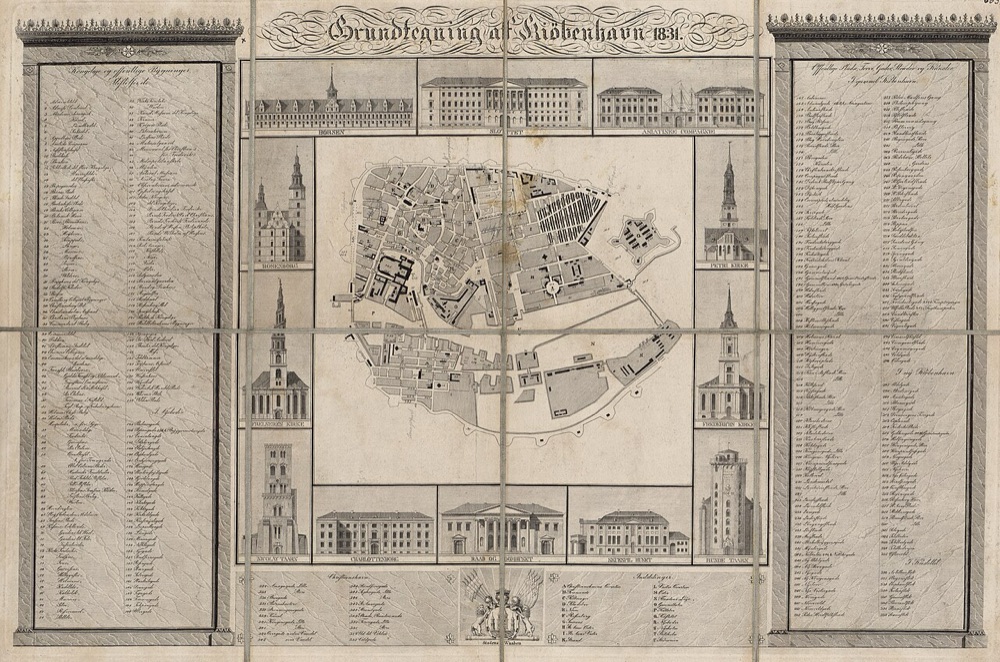
- Year
- 1813 · 5 May
The seventh and last child of Michael Pedersen Kierkegaard, a prosperous, guilt-haunted wool merchant, and Ane Sørensdatter Lund, formerly the household servant.
Image: Ground plan of Copenhagen, 1831. Public domain, via Wikimedia Commons.
References: Søren Kierkegaard Research Centre chronology; D. Anthony Storm's chronology.
- Year
- 1821
Borgerdydskolen, where his brother Peter had gone before him. His father chose it, and chose the classical side of it, which is where the Latin and the Greek that run under the pseudonymous books came from.
References: D. Anthony Storm's chronology.
- Year
- 1828 · 20 Apr
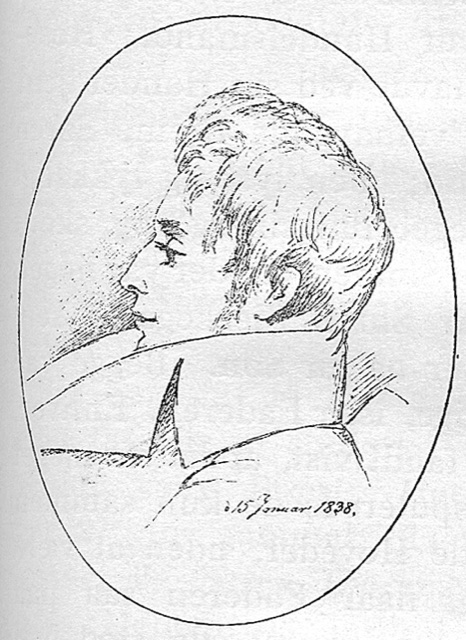
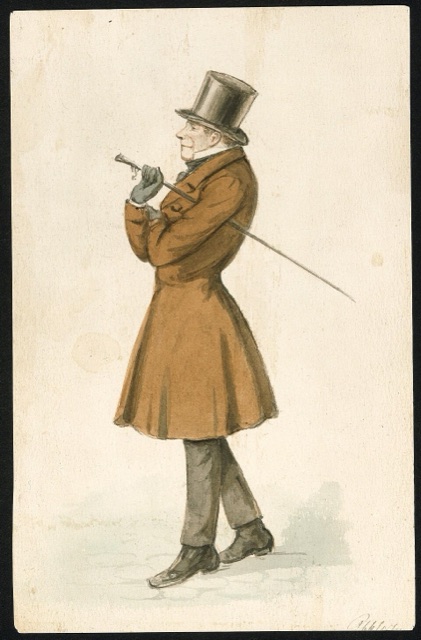
His confirmation was performed by Jacob Peter Mynster, his father's pastor and later Bishop of Zealand. Twenty-six years later Mynster's funeral eulogy would set off the attack that consumed the last two years of Kierkegaard's life.
Image: Kierkegaard in 1838, drawn by Niels Christian Kierkegaard. Public domain, via Wikimedia Commons.
References: D. Anthony Storm's chronology.
- Year
- 1830 · 30 Oct
Enrolled to read theology at his father's wish. He would take eleven years to finish. Days later he was drafted into the Royal Guard and discharged within the week as unfit for service.
Image: Kierkegaard at the Royal Library. Public domain, via Wikimedia Commons.
References: D. Anthony Storm's chronology.
- Year
- 1834 · 15 Apr
The first entry in the surviving journals is catalogued as I A 1. The journals and notebooks would eventually become a second body of writing larger than the published authorship.
References: D. Anthony Storm's chronology.
- Year
- 1834 · 31 Jul
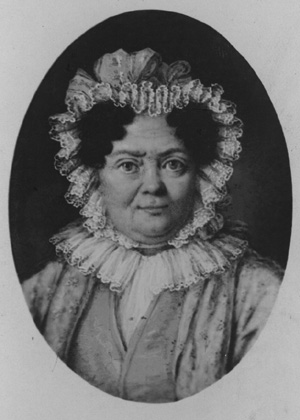
Ane Kierkegaard died in July 1834. Kierkegaard never once names her in the whole of his published writing.
Image: Ane Sørensdatter Lund Kierkegaard. Public domain, via Wikimedia Commons.
References: D. Anthony Storm's chronology.
- Year
- 1835 · 1 Aug
Twenty-two, on the north coast of Zealand, he wrote the sentence people still quote: what matters is “to find a truth which is truth for me, to find the idea for which I am willing to live and die.” He had four years of theology left to sit through and no intention of becoming a pastor.
References: the Gilleleje journal entry, 1 August 1835; D. Anthony Storm's chronology.
- Year
- 1835
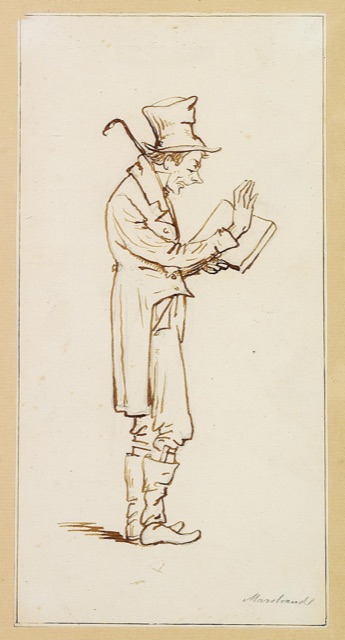
The journals record something he calls the great earthquake, after which he read his father, his family and himself entirely differently. What he actually learned is still argued over: the traditional account is that his father had cursed God as a boy herding sheep on the Jutland heath. The entry itself does not say.
Image: Drawing by Wilhelm Marstrand. Public domain, via Wikimedia Commons.
References: Stanford Encyclopedia of Philosophy.
- Year
- 1837 · 8–12 May
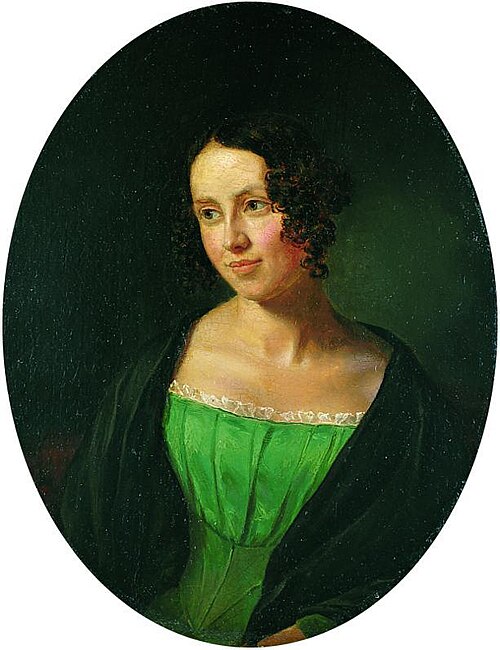
She was fourteen; he was twenty-four. The relationship, and its breaking, becomes the hidden engine of the pseudonymous authorship.
Image: Regine Olsen, portrait by Emil Bærentzen. Public domain, via Wikimedia Commons.
References: D. Anthony Storm's chronology.
Education, crisis, and Regine
1838–1842 2 works- Year
- 1838 · 19 May
In journal entry II A 228, Kierkegaard records an experience of “indescribable joy.” The chronology gives the experience without turning it into a settled conversion story.
References: D. Anthony Storm's chronology.
- Year
- 1838 · 9 Aug
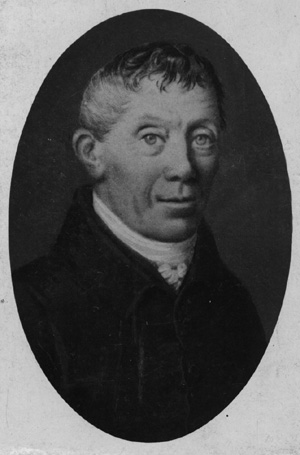
Michael Pedersen Kierkegaard died in August, leaving a fortune large enough to fund a lifetime of self-publishing, and a legacy of religious dread his son spent his life writing through.
Image: Michael Pedersen Kierkegaard. Public domain, via Wikimedia Commons.
References: Søren Kierkegaard Research Centre chronology; D. Anthony Storm's chronology.
- Year
- 1838 · 7 Sep
- Attributed
- Published against his Will by S. Kierkegaard
- Princeton
- KW I · Early Polemical Writings
- Read
- Open Library Storm Commentary Danish (SKS)
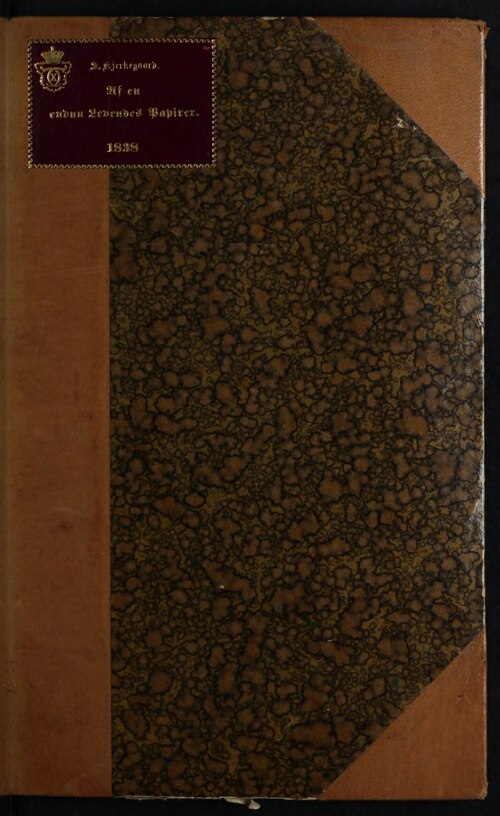
A hostile review of Hans Christian Andersen's novel Only a Fiddler, and Kierkegaard's first book. The mock-reluctant title page (published against the author's will) is already the whole later method in miniature.
Image: Bound first edition, 1838. Public domain, via Wikimedia Commons.
- Year
- 1840 · 3 Jul
He is now, formally, qualified for a parish he will never take.
References: Søren Kierkegaard Research Centre chronology; D. Anthony Storm's chronology.
- Year
- 1840 · c. 19 Jul–6 Aug
He travelled to the heath country around Sædding, where his father had grown up. It was his only substantial journey within Denmark recorded in the research chronologies.
References: Søren Kierkegaard Research Centre chronology; D. Anthony Storm's chronology.
- Year
- 1840 · 8 Sep
She accepted two days later. Within weeks he is convinced the engagement is a mistake.
References: Søren Kierkegaard Research Centre chronology; D. Anthony Storm's chronology.
- Year
- 1841 · 12 Jan
Kierkegaard preached while completing the pastoral seminary course. He qualified for ordination but was never ordained and never held a parish.
References: D. Anthony Storm's chronology.
- Year
- 1841 · 11 Aug–12 Oct
He returned the ring in August and ended the engagement finally in October, against Regine's pleading. Every pseudonymous book afterwards circles this act.
References: Søren Kierkegaard Research Centre chronology; D. Anthony Storm's chronology.
- Year
- 1841 · 29 Sep
- Attributed
- Magister dissertation
- Princeton
- KW II · The Concept of Irony
- Read
- Open Library Storm Commentary Danish (SKS)
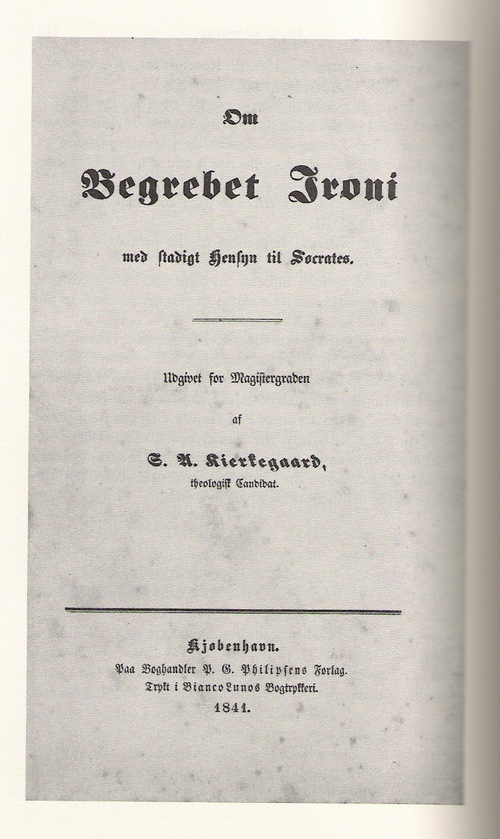
His dissertation, defended in September. Socratic irony, saying one thing to make the hearer discover another, becomes the operating principle of the pseudonymous authorship.
Image: First-edition title page, 1841. Public domain, via Wikimedia Commons.
- Year
- 1841 · 25 Oct–6 Mar 1842
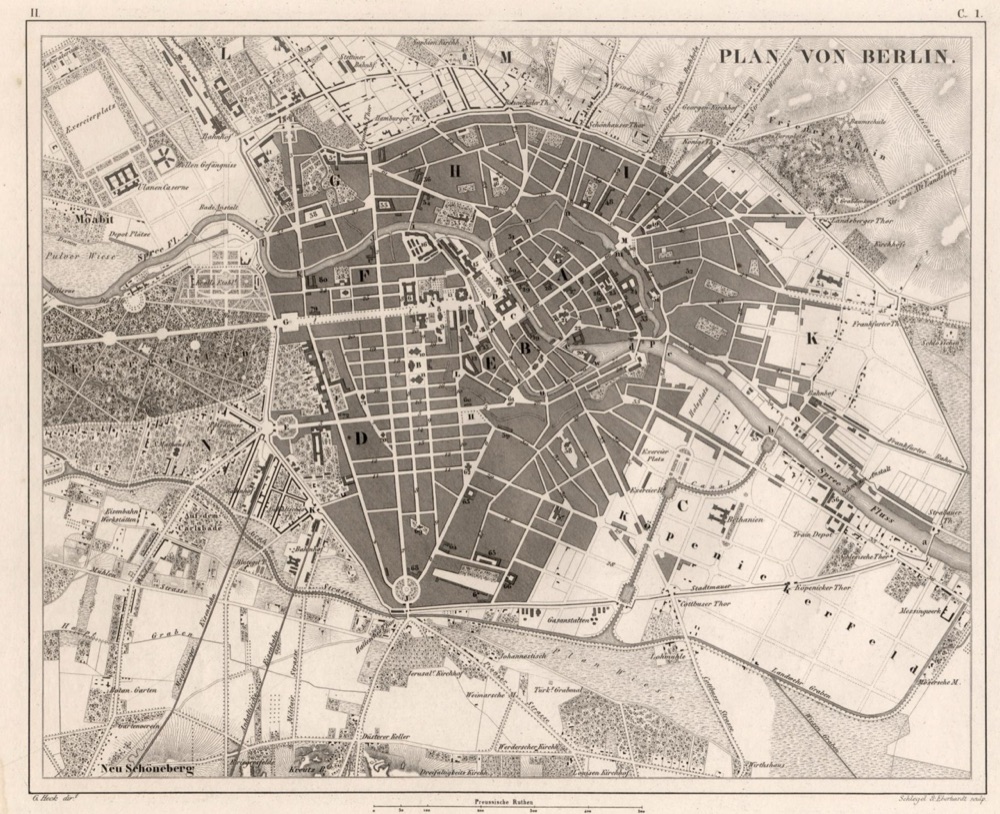
He went to hear Schelling on positive philosophy, hoping for a way past Hegel. He came away disappointed, and started writing Either/Or instead.
Image: Plan of Berlin, about 1850. Public domain, via Wikimedia Commons.
References: Søren Kierkegaard Research Centre chronology; D. Anthony Storm's chronology.
- Year
- 1842 · 6 Mar
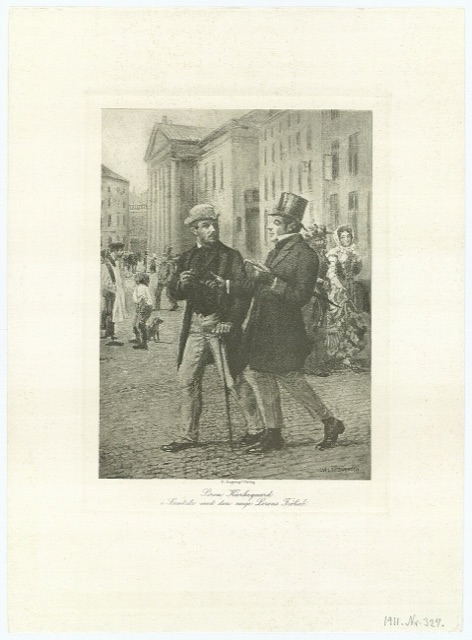
Back in Copenhagen with the manuscript of Either/Or largely drafted.
Image: Kierkegaard in conversation with the young Lorenz Frølich. Public domain, via Wikimedia Commons.
References: Søren Kierkegaard Research Centre chronology; D. Anthony Storm's chronology.
First authorship and the pseudonymous breakthrough
1843–1846 17 works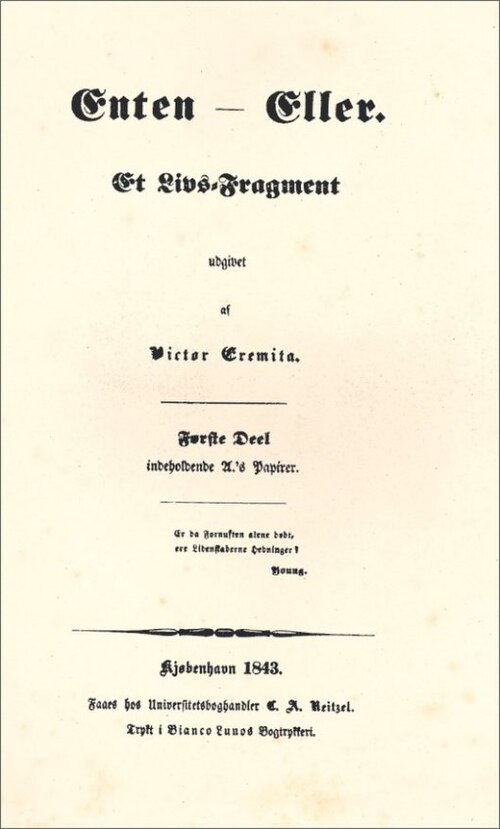
- Year
- 1843 · 20 Feb
- Attributed
- Victor Eremita
- Princeton
- KW III–IV · Either/Or
- Read
- Open Library Storm Commentary Danish I (SKS) Danish II (SKS)
Two volumes: the papers of an aesthete (A) set against the letters of a married judge (B), found in a secretary desk by the editor Victor Eremita, 'the victorious hermit'. The reader is handed the choice and given no author to appeal to.
Editor of Either/Or. He says he found the papers in a second-hand secretary desk and prints both sides without ruling between them, so the choice is handed to the reader with no author left to appeal to.
Image: First-edition title page, vol. I, 1843. Public domain, via Wikimedia Commons.
- Year
- 1843 · 8–30 May
A short return visit, undertaken partly as an experiment in whether repetition is possible. It was not.
References: Søren Kierkegaard Research Centre chronology.
- Year
- 1843 · 16 May
- Attributed
- S. Kierkegaard
- Princeton
- KW V · Eighteen Upbuilding Discourses
- Read
- Open Library Storm Commentary Danish (SKS)
Published under his own name three months after Either/Or, the first move in the double authorship. He called the discourses his 'right hand', offered while the world grabbed at the left.
- Year
- 1843 · Jul
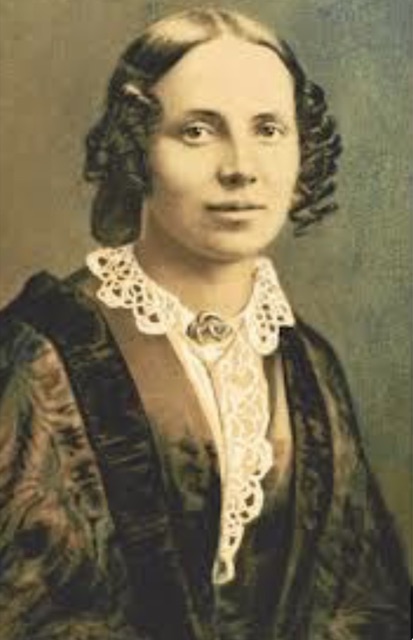
Two years after he returned the ring, she was engaged to Johan Frederik Schlegel, whom she had known before him. He kept writing about her for the rest of his life, and she outlived him by half a century.
Image: Regine Schlegel, née Olsen, in 1870. Public domain, via Wikimedia Commons.
References: D. Anthony Storm's chronology.
- Year
- 1843 · 16 Oct
- Attributed
- Johannes de Silentio
- Princeton
- KW VI · Fear and Trembling / Repetition
- Read
- Open Library Storm Commentary Danish (SKS)
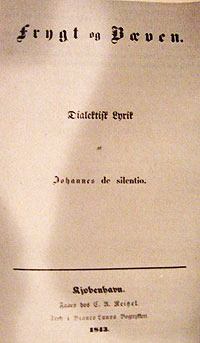
Abraham on the road to Moriah, retold four ways. 'Johannes of silence' can describe faith but confesses he cannot perform it.
He can describe faith in detail and says plainly that he cannot perform it. He writes about Abraham from outside, repeating that he does not understand him.
Image: First-edition title page, 1843. Public domain, via Wikimedia Commons.
- Year
- 1843 · 16 Oct
- Attributed
- Constantin Constantius
- Princeton
- KW VI · Fear and Trembling / Repetition
- Read
- Open Library Storm Commentary Danish (SKS)
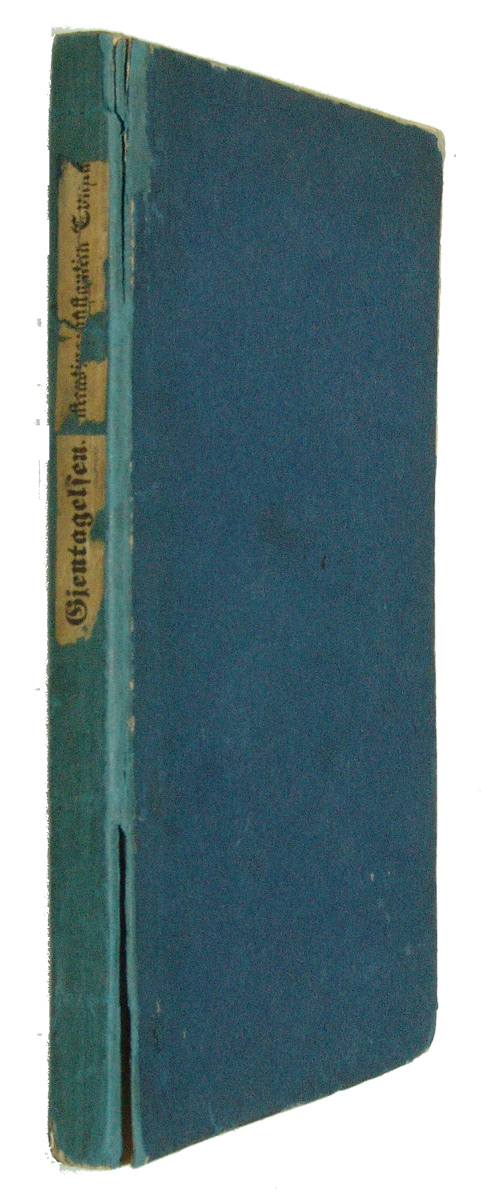
Published the same day as Fear and Trembling. A young man breaks his engagement; Constantius travels to Berlin to test whether an experience can be had twice. Job, not memory, supplies the answer.
He treats the question as an experiment, travelling to Berlin to test whether an experience can be had a second time, and reports that on his terms it cannot.
Image: First-edition binding, 1843. Public domain, via Wikimedia Commons.
- Year
- 1843 · 16 Oct
- Attributed
- S. Kierkegaard
- Princeton
- KW V · Eighteen Upbuilding Discourses
- Read
- Open Library Storm Commentary Danish (SKS)
Issued the same day as the two pseudonymous books: three titles, three names, one morning at Reitzel's bookshop.
- Year
- 1843 · 6 Dec
- Attributed
- S. Kierkegaard
- Princeton
- KW V · Eighteen Upbuilding Discourses
- Read
- Open Library Storm Commentary Danish (SKS)
Closing a year in which he published six books.
- Year
- 1843
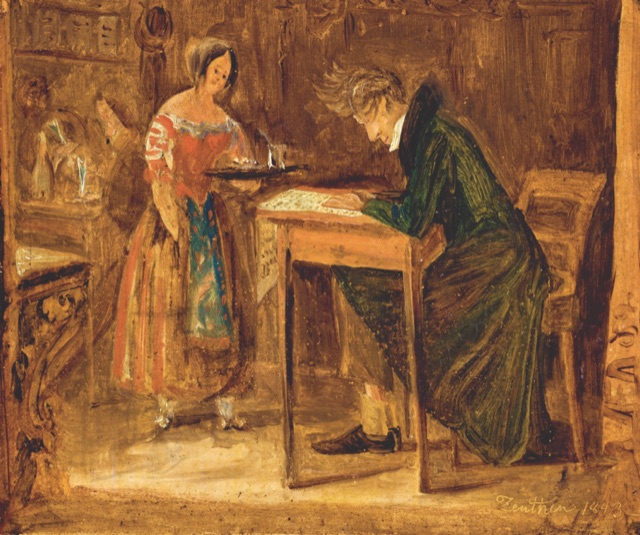
Christian Olavius Zeuthen painted him this year at a café table, hunched over a newspaper while the tray arrives. He worked standing at a high desk, then walked the city for hours, stopping anyone he knew. That visibility is what made him worth caricaturing three years later.
Image: Kierkegaard at a café table, painted by Christian Olavius Zeuthen, 1843. Public domain, via Wikimedia Commons.
References: Stanford Encyclopedia of Philosophy.
- Year
- 1844 · 24 Feb
One of the occasional Copenhagen sermons Kierkegaard delivered despite never taking orders or a parish.
References: D. Anthony Storm's chronology.
- Year
- 1844 · 5 Mar
- Attributed
- S. Kierkegaard
- Princeton
- KW V · Eighteen Upbuilding Discourses
- Read
- Open Library Storm Commentary Danish (SKS)
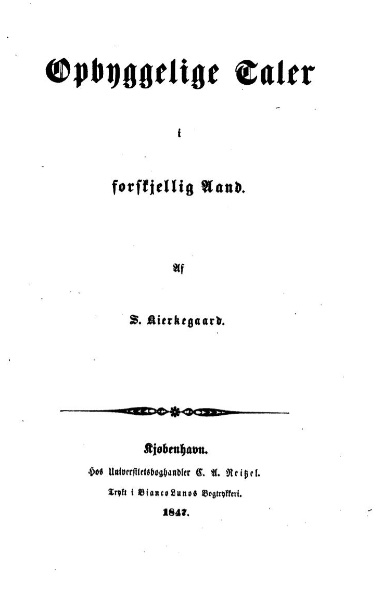
The pattern of the previous year resumes: signed discourses shadowing the pseudonymous works.
Image: First-edition title page, 1844. Public domain, via Wikimedia Commons.
- Year
- 1844 · 8 Jun
- Attributed
- S. Kierkegaard
- Princeton
- KW V · Eighteen Upbuilding Discourses
- Read
- Open Library Storm Commentary Danish (SKS)
Five days before Philosophical Fragments. The signed discourses keep arriving alongside the pseudonymous books, close enough that a reader in Copenhagen could buy both in the same week without knowing one man wrote them.
- Year
- 1844 · 13 Jun
- Attributed
- Johannes Climacus (published by S. Kierkegaard)
- Princeton
- KW VII · Philosophical Fragments / Johannes Climacus
- Read
- Open Library Storm Commentary Danish (SKS)
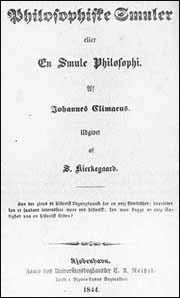
Can an eternal happiness be built on a historical fact? Climacus poses the question as a thought-experiment and never says the word Christianity until the reader has already said it for him.
A self-described humorist who states that he is not a Christian. He poses the question of Christianity from outside it, which is what lets him ask whether an eternal happiness can rest on a historical fact.
Image: First-edition title page, 1844. Public domain, via Wikimedia Commons.
- Year
- 1844 · 17 Jun
- Attributed
- Vigilius Haufniensis
- Princeton
- KW VIII · The Concept of Anxiety
- Read
- Open Library Storm Commentary Danish (SKS)
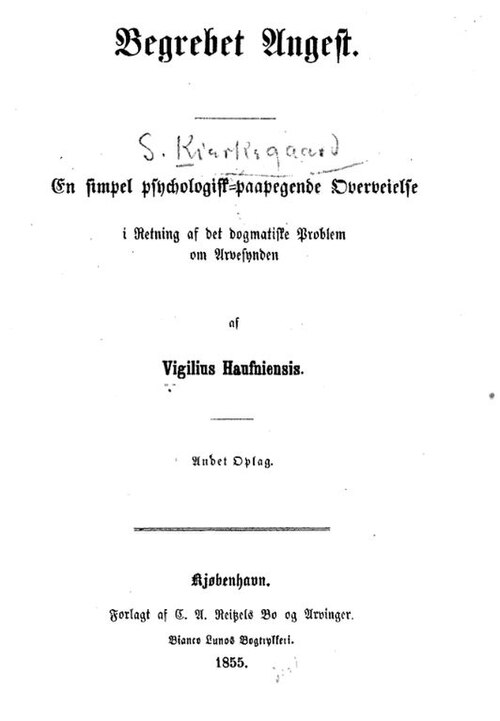
'The Watchman of Copenhagen' on original sin. Anxiety is defined as the dizziness of freedom: not fear of a thing, but the vertigo of possibility itself.
A watchman observes and reports. He diagnoses anxiety as the dizziness of freedom without offering to cure it.
Image: First-edition title page, 1844. Public domain, via Wikimedia Commons.
- Year
- 1844 · 17 Jun
- Attributed
- Nicolaus Notabene
- Princeton
- KW IX · Prefaces / Writing Sampler
- Read
- Open Library Storm Commentary Danish (SKS)
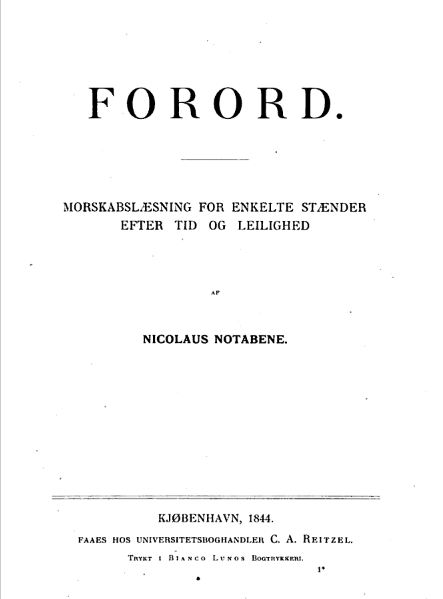
Published the same day as The Concept of Anxiety, and its exact tonal opposite: eight prefaces to books that do not exist, by a man whose wife forbids him to write.
A man whose wife treats writing as a kind of infidelity, so he writes only prefaces. Eight of them, to books that do not exist.
Image: First-edition title page, 1844. Public domain, via Wikimedia Commons.
- Year
- 1844 · 31 Aug
- Attributed
- S. Kierkegaard
- Princeton
- KW V · Eighteen Upbuilding Discourses
- Read
- Open Library Storm Commentary Danish (SKS)
The last of the eighteen discourses issued in twos, threes and fours across 1843 and 1844. He gathered them into a single volume the following spring, which is how they are usually read now.
- Year
- 1845 · 29 Apr
- Attributed
- S. Kierkegaard
- Princeton
- KW X · Three Discourses on Imagined Occasions
- Read
- Open Library Storm Commentary Danish (SKS)
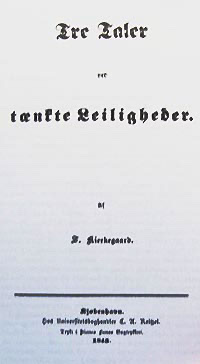
On confession, marriage and the graveside. Occasions imagined rather than commissioned: the pulpit he never had.
Image: First-edition title page, 1845. Public domain, via Wikimedia Commons.
- Year
- 1845 · 30 Apr
- Attributed
- Hilarius Bogbinder (compiler)
- Princeton
- KW XI · Stages on Life's Way
- Read
- Open Library Storm Commentary Danish (SKS)
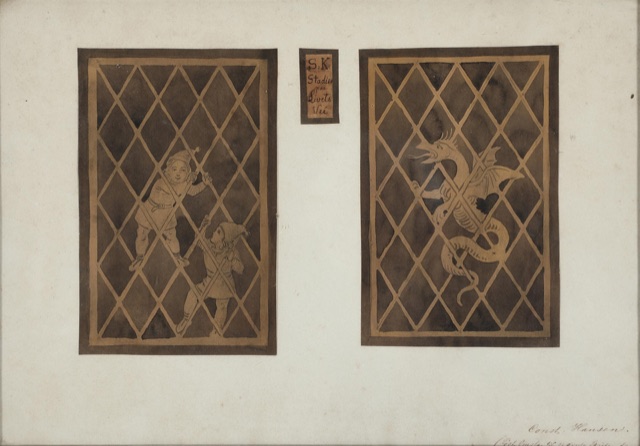
Aesthetic, ethical and religious set out as three stages, assembled by a bookbinder who cannot read what he is binding. The final section, 'Guilty?/Not Guilty?', is the engagement story told once more by Frater Taciturnus.
A tradesman who has bound and assembled papers he cannot read. He compiles Stages without claiming to understand what he is compiling.
Image: Constantin Hansen's study for the cover of Stadier paa Livets Vei. Public domain, via Wikimedia Commons.
- Year
- 1845 · 13–24 May
The third of four. Each Berlin trip is short, deliberate, and turns up afterwards inside a book.
References: Søren Kierkegaard Research Centre chronology; D. Anthony Storm's chronology.
- Year
- 1845 · 28 May
- Attributed
- S. Kierkegaard
- Princeton
- KW V · Eighteen Upbuilding Discourses
- Read
- Open Library Storm Commentary Danish (SKS)
A collected reissue gathering the remaindered discourses of 1843 and 1844 into one volume.
- Year
- 1845 · 27 Dec
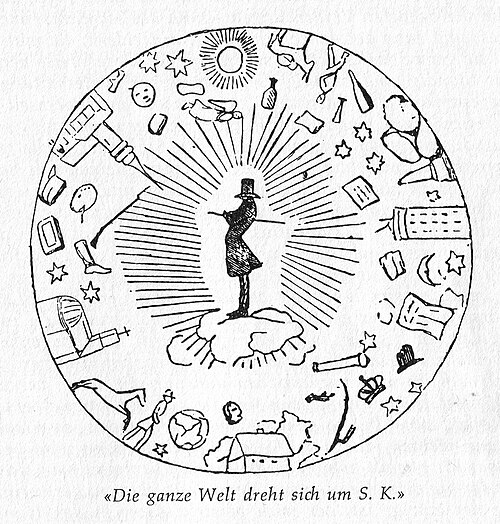
In an article in Fædrelandet, the pseudonym from Stages on Life's Way publicly requests abuse from Copenhagen's satirical weekly. He got it.
Deep dive The Corsair Affair: read the exchangeImage: Caricature from The Corsair, 1846. Public domain, via Wikimedia Commons.
References: Søren Kierkegaard Research Centre chronology; D. Anthony Storm's chronology.
- Year
- 1846 · 2 Jan–summer
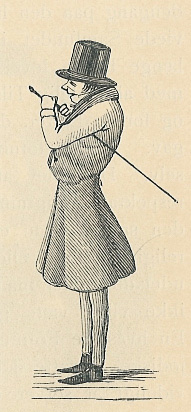
Months of caricature (trouser legs of unequal length, a crooked back) turned him into a figure children mocked in the street. It ended his habit of walking the city in conversation, and pushed the authorship toward direct religious confrontation.
Deep dive The Corsair Affair: see the caricaturesImage: Caricature from The Corsair, 1846. Public domain, via Wikimedia Commons.
References: D. Anthony Storm's chronology.
- Year
- 1846 · 7 Feb
During the Corsair affair he considered a clerical future. He instead remained at his post as an author; the Stanford biography connects that decision to the public aftermath of the affair.
References: D. Anthony Storm's chronology; Stanford Encyclopedia of Philosophy.
- Year
- 1846 · 27 Feb
- Attributed
- Johannes Climacus (published by S. Kierkegaard)
- Princeton
- KW XII · Concluding Unscientific Postscript
- Read
- Open Library Storm Commentary Danish (SKS)
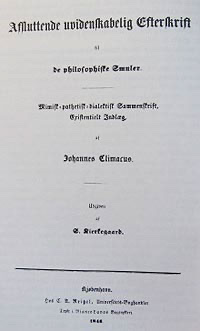
Five times the length of the book it supplements. 'Truth is subjectivity'; the System has no room for an existing individual. It closes with 'A First and Last Declaration' in which Kierkegaard finally acknowledges the pseudonyms, and disowns their opinions.
A self-described humorist who states that he is not a Christian. He poses the question of Christianity from outside it, which is what lets him ask whether an eternal happiness can rest on a historical fact.
Image: First-edition title page, 1846. Public domain, via Wikimedia Commons.
- Year
- 1846 · 30 Mar
- Attributed
- S. Kierkegaard
- Princeton
- KW XIV · Two Ages
- Read
- Open Library Storm Commentary Danish (SKS)
Ostensibly a review of a novella by Thomasine Gyllembourg; in fact a diagnosis of the present age as reflective, passionless and levelled by 'the public', the earliest sustained critique of mass society.
- Year
- 1846 · 2–16 May
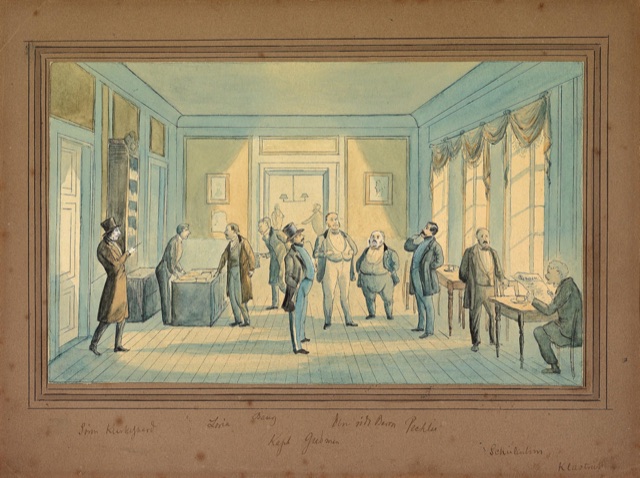
The last of four visits, and the last time he left Denmark apart from a brief crossing to Sweden. He had intended to stop writing after the Postscript and take a country parish. He never did either.
Image: Kierkegaard in a Copenhagen salon, by Peter Christian Klæstrup. Public domain, via Wikimedia Commons.
References: Søren Kierkegaard Research Centre chronology; D. Anthony Storm's chronology.
Second authorship and the Christian works
1847–1853 16 works- Year
- 1847 · 13 Mar
- Attributed
- S. Kierkegaard
- Princeton
- KW XV · Upbuilding Discourses in Various Spirits
- Read
- Open Library Storm Commentary Danish (SKS)
Opens with 'An Occasional Discourse', long known in English as 'Purity of Heart is to Will One Thing', a confessional address on double-mindedness, and one of the most widely read parts of the signed authorship.
- Year
- 1847 · 29 Sep
- Attributed
- S. Kierkegaard
- Princeton
- KW XVI · Works of Love
- Read
- Open Library Storm Commentary Danish (SKS)
On the commandment to love the neighbour: the one you actually have, not the one you would have chosen. His most sustained ethical work, and the one that most resists being read as pure interiority.
- Year
- 1847 · 3 Nov
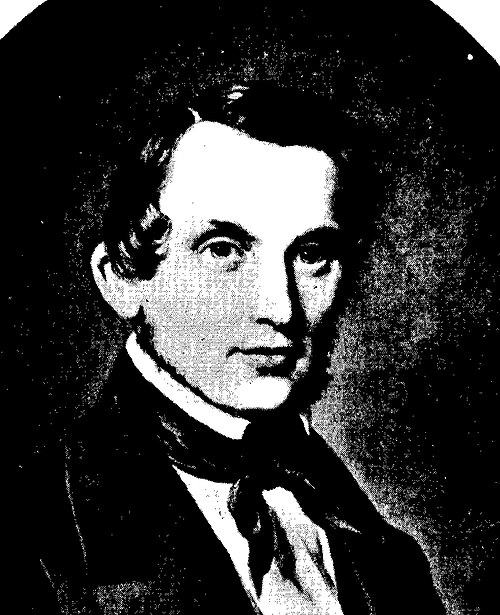
Kierkegaard learned of it and recorded the fact without comment; he later willed her his estate.
Image: Johan Frederik Schlegel. Public domain, via Wikimedia Commons.
References: Søren Kierkegaard Research Centre chronology.
- Year
- 1848 · 19 Apr
Kierkegaard writes that his nature is changed, his concealment and reserve broken, and that he is free to speak. It marks the increasingly direct character of the second authorship.
References: D. Anthony Storm's chronology.
- Year
- 1848 · 25 Apr
- Attributed
- S. Kierkegaard
- Princeton
- KW XVII · Christian Discourses / The Crisis
- Read
- Open Library Storm Commentary Danish (SKS)
Four parts: the anxieties of the pagan, the sufferings of the Christian, thoughts that wound from behind, and discourses at Friday communion.
- Year
- 1848 · 24–27 Jul
- Attributed
- Inter et Inter
- Princeton
- KW XVII · Christian Discourses / The Crisis
- Read
- Open Library Storm Commentary Danish (SKS)
A newspaper essay on the actress Johanne Luise Heiberg and the second youth of an artist, a deliberate late return to the aesthetic voice, to show it had not been abandoned but transcended.
A late and deliberate return to the aesthetic voice, writing on an actress and the second youth of an artist, to show the voice had been transcended rather than abandoned.
- Year
- 1848 · 1 Sep
A further public sermon in Copenhagen's cathedral, again without entering ordained ministry.
References: D. Anthony Storm's chronology.
- Year
- 1848
- Attributed
- S. Kierkegaard
- Princeton
- KW XXII · The Point of View
- Read
- Open Library Storm Commentary Danish (SKS)
- Note
- Unpublished in his lifetime
His own account of the authorship: that it was religious from the first, and the aesthetic works were a deception in the service of truth. He withheld it, judging that explaining the method would destroy it. Published posthumously in 1859.
- Year
- 1849 · 14 May
- Attributed
- Victor Eremita
- Princeton
- KW III–IV · Either/Or
- Read
- Open Library Storm Commentary Danish I (SKS) Danish II (SKS)
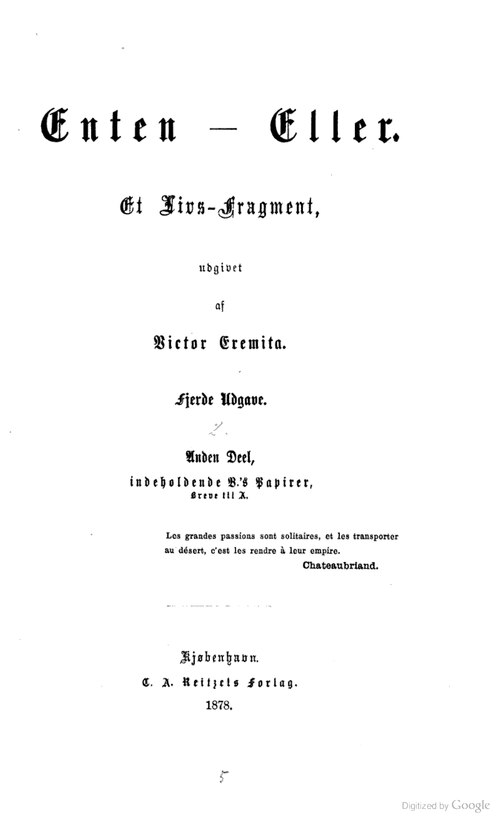
Reissued unchanged, deliberately, in the same month as new signed discourses: the two authorships placed side by side once more, six years on.
Editor of Either/Or. He says he found the papers in a second-hand secretary desk and prints both sides without ruling between them, so the choice is handed to the reader with no author left to appeal to.
Image: First-edition title page, vol. II, 1843. Public domain, via Wikimedia Commons.
- Year
- 1849 · 14 May
- Attributed
- S. Kierkegaard
- Princeton
- KW XVIII · Without Authority
- Read
- Open Library Storm Commentary Danish (SKS)
Three devotional discourses on Matthew 6: on being content, on obedience, on joy.
- Year
- 1849 · 19 May
- Attributed
- H.H.
- Princeton
- KW XVIII · Without Authority
- Read
- Open Library Storm Commentary Danish (SKS)
'Has a man the right to let himself be put to death for the truth?' and 'The difference between a genius and an apostle'. Authority, not brilliance, is what distinguishes the apostle.
He asks whether a person has the right to let himself be put to death for the truth, and separates the apostle's authority from the genius's brilliance.
- Year
- 1849 · 26 Jun
Terkild Olsen died in the summer of 1849. Kierkegaard had broken the engagement eight years earlier and was still writing about it; Regine had been married to Schlegel for eighteen months.
References: D. Anthony Storm's chronology.
- Year
- 1849 · 30 Jul
- Attributed
- Anti-Climacus (edited by S. Kierkegaard)
- Princeton
- KW XIX · Sickness Unto Death
- Read
- Open Library Storm Commentary Danish (SKS)
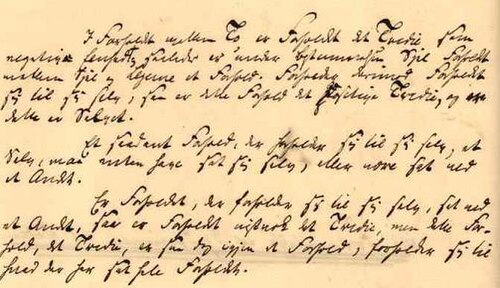
Despair, anatomised as the misrelation of a self that is a relation relating itself to itself. Anti-Climacus stands above Kierkegaard as Climacus stood below him, a Christian on an ideal level the editor does not claim to occupy.
Where Climacus stands below Christianity and says so, Anti-Climacus stands above it, writing as a Christian on an ideal level Kierkegaard did not claim to occupy. That is why Kierkegaard kept his own name on the title page as editor rather than as author: he would not sign what he could not live up to.
Image: Kierkegaard's manuscript of Sygdommen til Døden. Public domain, via Wikimedia Commons.
- Year
- 1849 · 13 Nov
- Attributed
- S. Kierkegaard
- Princeton
- KW XVIII · Without Authority
- Read
- Open Library Storm Commentary Danish (SKS)
Three Friday communion addresses on Christ as the one who sympathises, on the sinner who will not look up, and on the woman who loved much.
- Year
- 1850 · 18 Apr
He left his rooms at Rosenborggade for Nørregade, one of several addresses within the small centre of Copenhagen where almost his entire life unfolded.
References: D. Anthony Storm's chronology.
- Year
- 1850 · 27 Sep
- Attributed
- Anti-Climacus (edited by S. Kierkegaard)
- Princeton
- KW XX · Practice in Christianity
- Read
- Open Library Storm Commentary Danish (SKS)
Contemporaneity with Christ, the offence, and the invitation 'Come here, all you who labour'. The sharpest thing he published while still inside the Church, and the book Bishop Mynster took as a personal attack.
Where Climacus stands below Christianity and says so, Anti-Climacus stands above it, writing as a Christian on an ideal level Kierkegaard did not claim to occupy. That is why Kierkegaard kept his own name on the title page as editor rather than as author: he would not sign what he could not live up to.
- Year
- 1850 · 20 Dec
- Attributed
- S. Kierkegaard
- Princeton
- KW XVIII · Without Authority
- Read
- Open Library Storm Commentary Danish (SKS)
On the woman who was a sinner. A single discourse, issued alone.
- Year
- 1851 · 31 Jan
Kierkegaard's open letter rejected Rudelbach's appeal to him in a programme for church reform, especially the attempt to pursue spiritual reform through political means.
References: Søren Kierkegaard Research Centre chronology; D. Anthony Storm's chronology.
- Year
- 1851 · 7 Aug
- Attributed
- S. Kierkegaard
- Princeton
- KW XXII · The Point of View
- Read
- Open Library Storm Commentary Danish (SKS)
The short, publishable version of The Point of View: an admission of the strategy without the full disclosure.
- Year
- 1851 · 7 Aug
- Attributed
- S. Kierkegaard
- Princeton
- KW XVIII · Without Authority
- Read
- Open Library Storm Commentary Danish (SKS)
Published the same day as his account of the authorship, and the quieter half of that pairing. At the communion rail the polemic stops and the address turns personal.
- Year
- 1851 · 10 Sep
- Attributed
- S. Kierkegaard
- Princeton
- KW XXI · For Self-Examination / Judge for Yourself!
- Read
- Open Library Storm Commentary Danish (SKS)
On reading Scripture as a letter from a lover rather than a text to be construed: 'the mirror of the Word'.
- Year
- 1851
- Attributed
- S. Kierkegaard
- Princeton
- KW XXI · For Self-Examination / Judge for Yourself!
- Read
- Open Library Storm Commentary Danish (SKS)
- Note
- Published 1876
Written as the second series to For Self-Examination and held back. It appeared posthumously in 1876, twenty-one years after his death.
- Year
- 1852
After September 1851 he published nothing for more than three years. He kept writing, and much of what became the attack was drafted in this gap, but nothing went to the printer. The Research Centre's chronology records no entries at all for 1852 or 1853. The silence is not missing evidence; it is what happened.
References: Søren Kierkegaard Research Centre chronology; D. Anthony Storm's chronology.
Late polemics and the attack on Christendom
1854–1855 5 works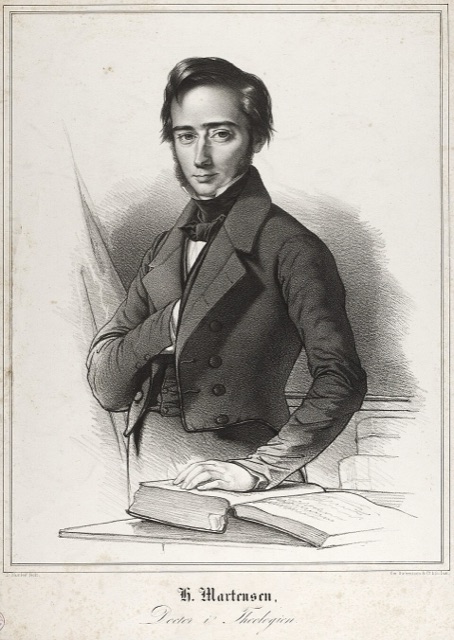
- Year
- 1854 · 30 Jan–15 Apr
Jacob Peter Mynster, his father's pastor and the establishment Christianity he had circled for a decade, died in January. Hans Lassen Martensen's funeral eulogy calling Mynster 'a witness to the truth' was the spark.
Image: Hans Lassen Martensen. Public domain, via Wikimedia Commons.
References: Søren Kierkegaard Research Centre chronology; D. Anthony Storm's chronology.
- Year
- 1854 · 18 Dec
- Attributed
- S. Kierkegaard, in Fædrelandet
- Princeton
- KW XXIII · The Moment and Late Writings
- Read
- Open Library Storm Commentary Danish (SKS)
He sat on the article for ten months, then published. The first of twenty-one pieces in Fædrelandet. The indirect method is over.
- Year
- 1855 · 24 May
- Attributed
- S. Kierkegaard
- Princeton
- KW XXIII · The Moment and Late Writings
- Read
- Open Library Storm Commentary Danish (SKS)
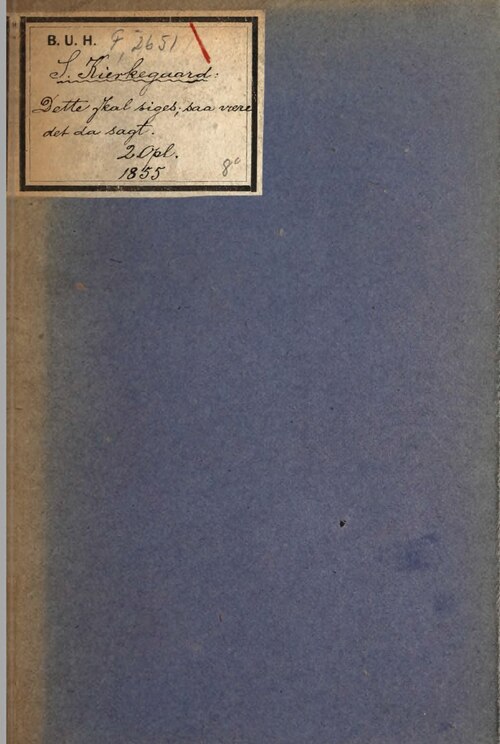
Stop taking part. Whoever you are, refuse to participate in the official worship of God as it now stands. That alone is the one great guilt.
Image: First edition, 1855. Public domain, via Wikimedia Commons.
- Year
- 1855 · 26 May–25 Sep
- Attributed
- S. Kierkegaard
- Princeton
- KW XXIII · The Moment and Late Writings
- Read
- Open Library Storm Commentary Danish (SKS)
Nine pamphlets written, funded and distributed by himself. A tenth was found on his desk. The prose is stripped to almost nothing: the New Testament's Christianity does not exist, and official Christianity is a forgery.
- Year
- 1855 · 16 Jun
- Attributed
- S. Kierkegaard
- Princeton
- KW XXIII · The Moment and Late Writings
- Read
- Open Library Storm Commentary Danish (SKS)
He sets the New Testament's words about scribes and Pharisees against the Danish state church and leaves the reader to draw the line. One of the last things he published before he collapsed in the street.
- Year
- 1855 · 3 Sep
- Attributed
- S. Kierkegaard
- Princeton
- KW XXIII · The Moment and Late Writings
- Read
- Open Library Storm Commentary Danish (SKS)
A sermon preached in 1851 and published now, at the height of the attack, and the last thing he saw through the press. God does not change; you are the one who must move.
- Year
- 1855 · 2 Oct
He collapsed in the street and was admitted to Frederiks Hospital. He remained there for forty days.
References: Søren Kierkegaard Research Centre chronology; D. Anthony Storm's chronology; Stanford Encyclopedia of Philosophy.
- Year
- 1855 · 11 Nov
He died in Frederiks Hospital, aged forty-two, after forty days there. His inheritance was spent almost exactly to the end: he had calculated how long the money would last and outlived it by very little.
References: Søren Kierkegaard Research Centre chronology; D. Anthony Storm's chronology.
- Year
- 1855 · 18 Nov
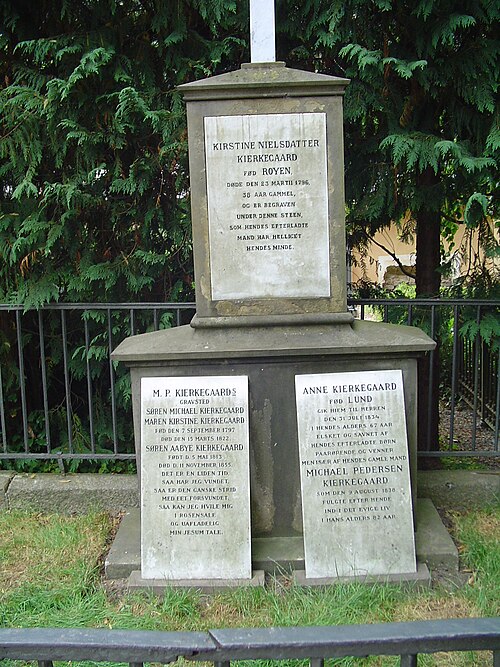
The funeral was held in the Church of Our Lady and the burial at Assistens Kirkegård, both conducted by the establishment he had spent his last year attacking. At the graveside his nephew Henrik Lund protested that Kierkegaard would never have consented to it. Lund was fined for the interruption.
Image: Grave, Assistens Kirkegård, Copenhagen. Public domain, via Wikimedia Commons.
References: Stanford Encyclopedia of Philosophy; D. Anthony Storm's chronology.